Remarkable Seagrass
May 8, 2026
Meet Joana
May 8, 2026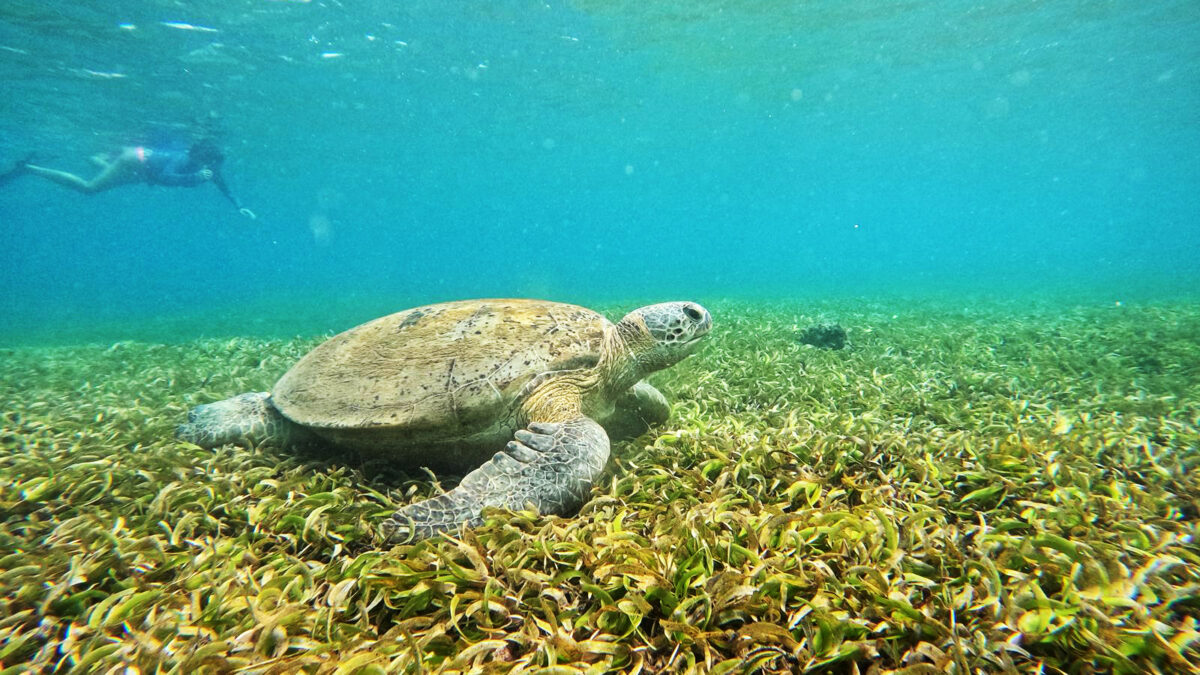
Photo credit: Jonah German
Covering only about 0.2% of the ocean floor, seagrass meadows are small in area but enormous in ecological impact. Found in shallow coastal waters, their growth is limited by light (up to ~60 m), nutrients, temperature, and salinity. Seagrass stabilises sediments, improves water quality, cycles nutrients, stores carbon, and oxygenates both water and sediment. They form the foundation of rich food webs, supporting everything from tiny grazers to predators, and are crucial habitats for larger herbivores like manatees and adult green sea turtles. Around one-fifth of commercially caught fish rely on these ecosystems, contributing to global food security. Madeira hosts Little Neptune grass (Cymodocea nodosa), a species adapted to local coastal conditions. Seagrasses are unique as the only true plants in the ocean. Their ancestors originated in the sea, moved onto land, and then – around 100 million years ago – evolved back to the ocean, making them truly remarkable. They reproduce both sexually, through water-mediated pollination, and asexually via rhizomes.
Kelp forests, in contrast, dominate temperate and polar coastlines, forming dense “forests” of large brown macroalgae. Anchored by holdfasts to rocky seafloors, kelp fronds reach toward sunlight and provide habitat, food, and nursery grounds for hundreds of marine species. They reproduce via spores that grow into gametophytes, eventually producing the large kelp sporophytes we see. There are over 100 kelp species worldwide, including Macrocystis, Laminaria, and Ecklonia, with deep-water populations of Laminaria ochroleuca documented in Madeira. Giant kelp (Macrocystis pyrifera) is one of the fastest-growing organisms on Earth, growing up to 60 cm per day.
Both seagrass and kelp are in rapid decline due to human activities. Seagrass has lost roughly 29% of global coverage, with 24% of species threatened, primarily from eutrophication, overfishing, physical damage, urbanisation, and sea level rise. Kelp forests are similarly threatened by warming, marine heatwaves, overfishing, and pollution, with some regions losing up to 60% of their historic extent.
Despite these threats, protecting and restoring these ecosystems is vital for biodiversity and climate mitigation. Both seagrass and kelp stabilise sediments, buffer coasts from erosion and storms, cycle nutrients, improve water quality, and provide habitat for countless species, maintaining resilient marine food webs. They store large amounts of carbon—seagrass alone accounts for around 10% of ocean carbon burial—and kelp exports carbon to deeper waters. Both also filter pollutants like excess nitrogen and phosphorus and reduce harmful bacteria linked to human sewage, safeguarding marine life and human health. Conserving what remains is far more effective than attempting to restore lost areas, making the protection of existing seagrass and kelp forests a top priority.
Looking ahead, the future of kelp offers exciting possibilities alongside protection efforts. Kelp farming is expanding globally as a sustainable industry producing biodegradable plastics, natural fertilisers, animal feed, and carbon sequestration opportunities. Integrated seaweed and shellfish aquaculture can enhance biodiversity and water quality while supporting coastal economies. By combining protection of existing meadows and forests with responsible kelp cultivation, we can simultaneously combat biodiversity loss, mitigate climate change, and support sustainable food and livelihoods for millions of people.
Curious and want to contribute?
There are great source out there to contribute to the understanding of and learn more about seagrass: For example Seagrassspotter.org where you can report sightings, or just have a look where other people around the world found seagrass. Another interesting project is seagrasswatch.org, which is more long term scientific monitoring.
By Eva Koehle