BWB – Madeira’s weather
April 14, 2026
11.04.2026 – Salt crust
April 18, 2026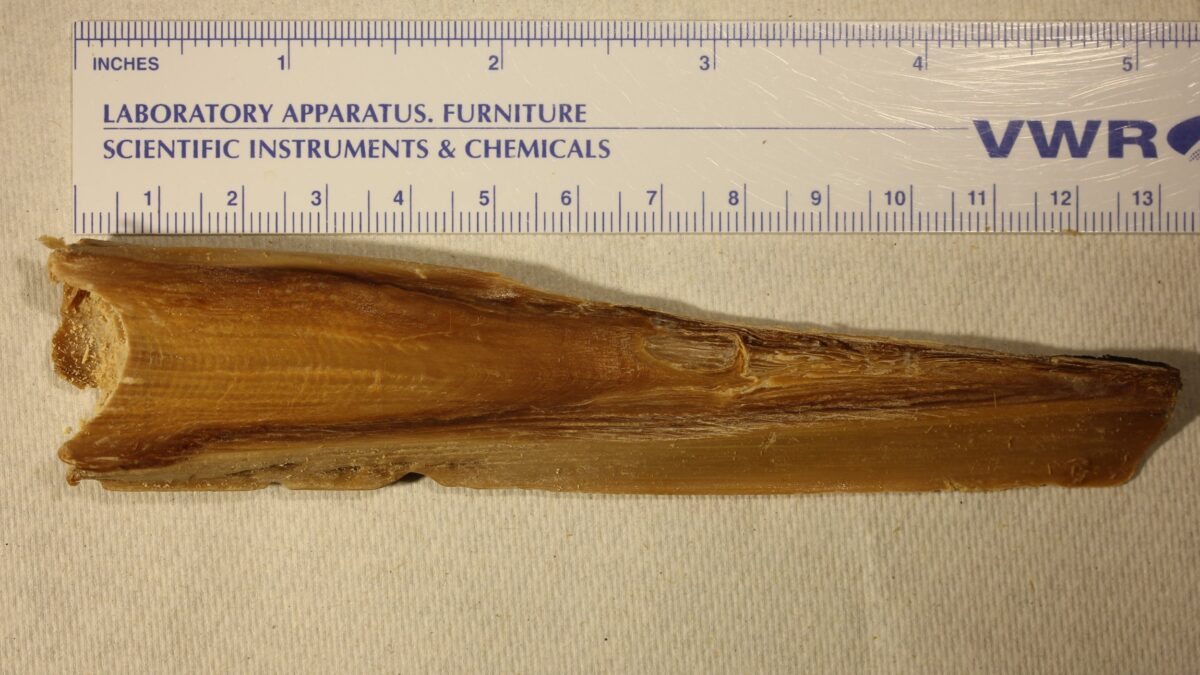
For baleen whales (Mysticete’s) like humpback, minke, fin, and blue whales, one of the most surprising ways to tell their age is by looking inside their ears.
Just like humans, whales produce earwax – but unlike ours, theirs doesn’t leave the ear. Their ear canal is largely sealed, so the wax accumulates into a solid earplug, growing in layers much like the rings of a tree. Each layer reflects the whale’s seasonal migration and feeding cycles: during summer in nutrient-rich waters, whales feed intensely, producing lighter wax layers, while in winter, during migration to warmer breeding grounds, they fast, producing darker layers. One light-and-dark pair represents roughly one year of the whale’s life.
But earplugs are more than a biological calendar. Each layer is a tiny time capsule, preserving chemical clues from that moment in the whale’s life. Scientists can analyse them to measure stress hormones like cortisol, revealing how the whale responded to events such as food shortages, noise pollution, or human activity. They can also track pollutants like mercury and PCBs, showing how ocean contamination has shifted and accumulated over decades.
Earplugs provide an evolutionary advantage for all baleen whales, helping protect the ear from pressure changes, cold water, and debris, and maintaining stable underwater hearing. In blue whales, for example, earplugs can reach up to 30 centimetres in length and weigh nearly 1 kilogram, giving a striking sense of the scale of these natural “time capsules.”
Today, a few thousand whale earplugs exist in museum and research collections, though most are tucked away for scientific study rather than on public display. In their layers, whales leave behind a remarkable story – a decades-long record of life in the ocean. The more we learn from them, the better we can protect these giants and the oceans they call home.
© Photo by Newsweek Digital LLC
By Eva Köhle